 Skip to main content


Why Linen Is the Highest-Margin—Yet Highest-Risk—Category for Resortwear & Boutique Brands
Across the US, Australian, UK, and Mediterranean contemporary womenswear markets, linen and resortwear command premium retail price points ($140 to $350+ at boutique retail). Yet linen is also the #1 source of customer returns when manufactured by factories that treat flax like standard woven polyester or cotton poplin. Without proper technical engineering, brands face three recurring disasters: excessive post-wash shrinkage (up to 1.5 sizes smaller after the customer’s first wash), unwanted sheerness on white and pastel colourways, and coarse hand-feel or seam slippage at stress points.
As a specialized resortwear and linen clothing manufacturer based in Panyu, Guangzhou, we have produced linen collections since 2013 for global D2C and boutique labels. Below is the exact factory specification guide our fabric sourcers, CAD pattern makers, and QC inspectors use across our custom linen clothing manufacturing line.

1. 100% Pure Linen vs. Linen-Viscose vs. Linen-Cotton: Selecting the Right Fiber & GSM
Not every silhouette in a summer capsule should be cut from 100% pure flax. While 100% long-staple linen (sourced from normative Normandy/European flax yarns) offers unmatched breathability, crisp organic slub texture, and high perceived value, its low elasticity means it creases sharply and requires precise dart and ease engineering. Blending linen with viscose (rayon), Lyocell (Tencel), or combed cotton alters drape, wrinkle recovery, and price point dramatically.
| Fabric Composition | Ideal GSM Range | Drape & Hand-Feel | Wrinkle Recovery | Raw vs. Pre-Shrunk Shrinkage Rate | Opacity & Lining Requirement | Best Garment Applications |
|---|---|---|---|---|---|---|
| 100% Pure Linen (14s×14s or 14s×12s Mid-Weight) | 155 – 175 GSM | Crisp, structured organic slub; softens with every wash | Low (Classic natural linen creasing) | Raw: 5%–7% Pre-Washed: ≤2.5% | Dark colours opaque; Ivory/White requires 100% Cotton Voile lining | Tailored custom linen dresses, shift dresses, structured vests, wide-leg trousers |
| 100% Lightweight Handkerchief Linen (21s×21s) | 120 – 138 GSM | Airy, semi-sheer, ultra-breathable coastal feel | Low to Moderate | Raw: 4%–6% Pre-Washed: ≤2.5% | Semi-sheer across all shades; ideal for beach cover-ups or lined bodices | Oversized custom linen tops, resort shirts, pareos, tiered beach maxi dresses |
| 100% Heavyweight Suiting Linen (9s×9s or 10s×10s) | 190 – 220 GSM | Substantial, architectural weight with rich texture | Moderate | Raw: 5%–8% Pre-Washed: ≤3.0% | 100% Opaque even in light sand/oatmeal shades | Unlined tailored blazers, structured linen pants and shorts, utility jackets |
| 55% Linen / 45% Viscose (or Rayon/Tencel Blend) | 145 – 170 GSM | Fluid, silky drape; significantly softer against bare skin | High (Resists sharp creasing during wear & travel) | Raw: 6%–9% (Viscose contracts when wet) Pre-Shrunk + Paper-Built Pattern: ≤3.0% | High density; light shades require half-lining on skirts/bodices | Bias-cut midi dresses, ruched bodices, flowy wide-leg palazzos, wrap skirts |
| 55% Linen / 45% Combed Cotton | 150 – 180 GSM | Soft, matte, stable weave with subtle slub texture | Moderate to High | Raw: 4%–5% Pre-Washed: ≤2.0% | High opacity; easy care for everyday boutique staples | Everyday shirt dresses, structured shorts, summer co-ord sets, A-line skirts |
2. How Our Factory Eliminates the #1 Linen Nightmare: 3-Stage Shrinkage Control
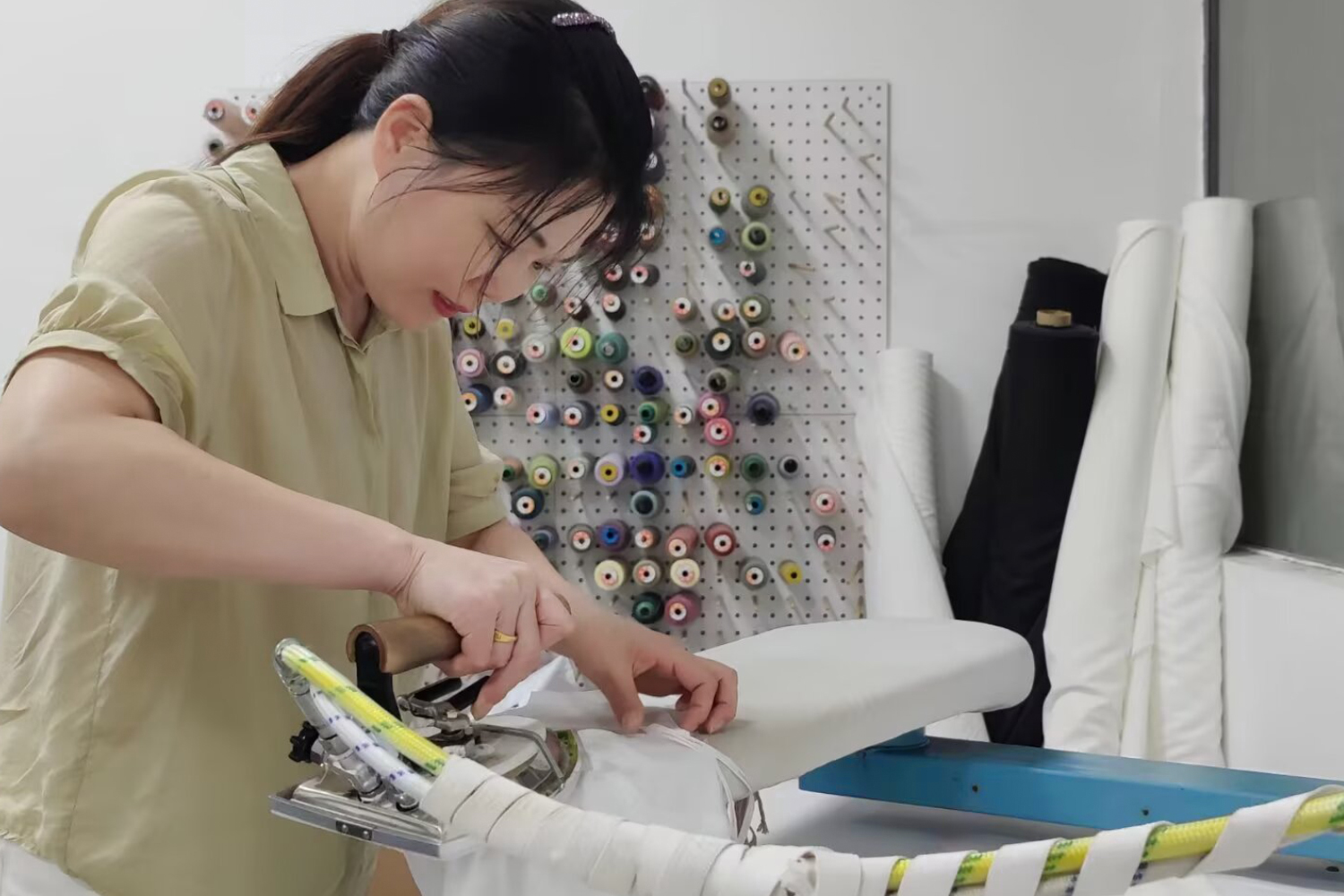
If a factory cuts bulk linen directly off the raw fabric bolt without testing and pre-treating it, a garment that measures perfectly on the packing table will shrink 5% to 8% in length and chest width the first time your customer washes it. At Tuer Garment, every bulk order of linen dresses, linen tops, and linen bottoms undergoes a mandatory three-stage stabilization protocol:
- Roll-by-Roll Lab Shrinkage Testing: When bulk fabric rolls arrive at our Panyu Guangzhou warehouse, we cut a 50cm × 50cm test square from each dye lot, run a standardized wash and steam-press cycle, and measure exact warp (lengthwise) and weft (widthwise) contraction percentages.
- Industrial Pre-Shrinking & Softening before Cutting (or Pattern Shrinkage Allowance): Depending on the target hand-feel, we either pass the bulk fabric through an industrial steam/water pre-shrinking and silicone/enzyme softening machine prior to cutting, OR build the exact warp/weft shrinkage percentage directly into the CAD pattern marker so the garment shrinks down to exact spec during post-sewing garment washing.
- Garment Enzyme Wash & Final Steam Stabilization: For brands seeking that signature buttery-soft Australian coastal linen hand-feel right out of the polybag, finished garments undergo a controlled enzyme bio-wash that removes surface fuzz and locks in residual dimensional stability at ≤2%–3% tolerance.
Sourcing Linen Swatches for Your Next Resortwear Drop?
We send physical fabric swatch books (100% European Flax linen, linen-viscose, and linen-cotton blends across 40+ stock shades) along with your first prototype so you can test opacity, weight, and hand-feel firsthand.
3. Opacity, Lining & Seam Engineering for Boutique-Grade Resortwear
Luxury resortwear buyers immediately inspect the inside of a garment to judge quality. Because linen fibers are spun from thicker, irregular flax bast fibers, low-stitch-density sewing or cheap polyester linings instantly ruin a $200+ retail dress.
When we engineer custom linen apparel at our 150–200 piece MOQ, we standardize four critical construction upgrades:
| Construction Element | Low-End Factory Shortcut (What to Avoid) | TUER Garment Boutique Standard | Why It Matters for Your Brand |
|---|---|---|---|
| Lining Fabric for White/Pastel Linen | 65g–80g 100% Polyester Pongee (Traps heat, creates static cling, ruins linen breathability) | 100% Combed Cotton Voile (60s×60s, 75–90 GSM) or breathable Rayon/Viscose challis, pre-shrunk to match the outer shell | Preserves 100% natural breathability in hot climates while guaranteeing zero see-through transparency on ivory, white, and butter-yellow styles. |
| Internal Seam Finishing | Loose 3-thread overlock with narrow 0.6cm seam allowance (causes seam slippage & fraying in linen) | Enclosed French Seams (on unlined shirts/dresses), Hong Kong bound seams, or high-density 4/5-thread safety overlock with 1.2cm–1.5cm seam allowance | Prevents open-weave flax yarns from pulling apart at high-tension areas (hip seams, armholes, bust darts, and back zippers). |
| Stitch Density (SPI) & Thread | 8–9 stitches per inch with coarse spun poly thread (puckers lightweight linen) | 11–13 Stitches Per Inch (SPI) using fine core-spun thread and ballpoint/sharp needles calibrated to GSM | Creates flat, pucker-free topstitching on collars, plackets, and wide-leg hems even after repeated laundering. |
| Interlining & Hardware | Stiff heavy nonwoven fusing that bubbles after washing; generic metal zippers that rust in coastal humidity | Lightweight woven cotton/charmeuse fusible interlining; genuine Trocas/Agoya shell buttons, natural coconut/corozo buttons, and YKK nylon invisible zippers | Delivers an elevated coastal aesthetic that withstands salt air, humidity, and machine hand-wash cycles. |
4. How to Plan Your Linen Collection Timeline & MOQs
Peak retail selling windows for linen and resortwear require disciplined backward scheduling. Whether you are producing for Northern Hemisphere Spring/Summer (delivering February–May), Australian/Southern Hemisphere Summer (delivering September–December), or year-round vacation capsules, here is how our schedule locks in your launch dates:
- MOQ Flexibility: 200 pieces per style for 1 colour, or 150 pieces per colour per style for 2 or more colours (up to 4 mixed sizes). This makes it easy to launch a core linen dress or trouser silhouette in White + Natural Flax or Black + Olive at 150 units per shade.
- Cost Estimate: 2–3 working days from receiving your tech pack, reference sample, or design sketch.
- Custom Sampling & Swatch Approval: 5–10 working days. We source and attach alternative GSM and blend swatches with your physical sample so you can compare 100% linen against linen-viscose side by side.
- Bulk Production Turnaround: 30–45 working days for first orders; 15–30 working days for repeat orders once fabric and deposit (30%) are confirmed.
Develop Your Next Linen & Resortwear Capsule With TUER
From 100% European Flax linen maxi dresses to breathable linen-viscose two-piece sets, our Guangzhou sampling and production team handles fabric sourcing, pre-shrinking, custom shell trims, and global EXW/FOB/DDP shipping.
Frequently Asked Questions: Custom Linen Clothing Manufacturing
1. Can you source certified European Flax™ or OEKO-TEX® linen at a 150–200 piece MOQ?
Yes. Through our vetted mill partners in Guangzhou and eastern China, we source both certified European Flax™ (Masters of FLAX FIBRE™) and OEKO-TEX® Standard 100 linen and linen-blend fabrics that are available in ready-stock greige and dyed shades, allowing you to access certified sustainable fabrics at our 150–200 piece MOQ.
2. How do you prevent white and cream linen dresses from being see-through?
For white, ivory, and pastel linen garments, we recommend a mid-to-heavy outer shell (165–190 GSM) paired with a breathable, pre-shrunk 100% cotton voile full or half lining (75–90 GSM). During the 5–10 day sampling phase, we test opacity under studio lighting and send photos and physical swatches for your approval before bulk cutting.
3. What happens if my linen shell fabric and cotton lining have different shrinkage rates?
If an outer linen shell shrinks 4% while a cotton voile lining shrinks 1.5%, the hem will pucker and pull after washing. We prevent this by testing both the shell fabric and the lining fabric independently and pre-shrinking both materials before cutting so their residual shrinkage rates are matched within ±1%.
4. Can you do custom prints or embroidery on linen garments at 150–200 MOQ?
Yes. High-definition digital reactive printing works exceptionally well on 100% linen and linen-viscose blends for botanical, paisley, and resort placement prints without high screen-setup fees at 150–200 pieces. We also execute custom tonal eyelet (broderie anglaise), contrast ric-rac trim, and 3D embroidery.


