 Skip to main content


Why No Single Factory Floor Can Produce a Full Multi-Category Womenswear Collection Alone
One of the most expensive mistakes international fashion brands make when sourcing in China is assuming that any “clothing factory” can manufacture woven silk-blend midi dresses, 12-gauge Merino wool cardigans, and enzyme-washed rigid denim jeans under the exact same roof. In reality, modern apparel manufacturing relies on completely different industrial machinery, technical craftsmanship, and upstream raw material ecosystems:
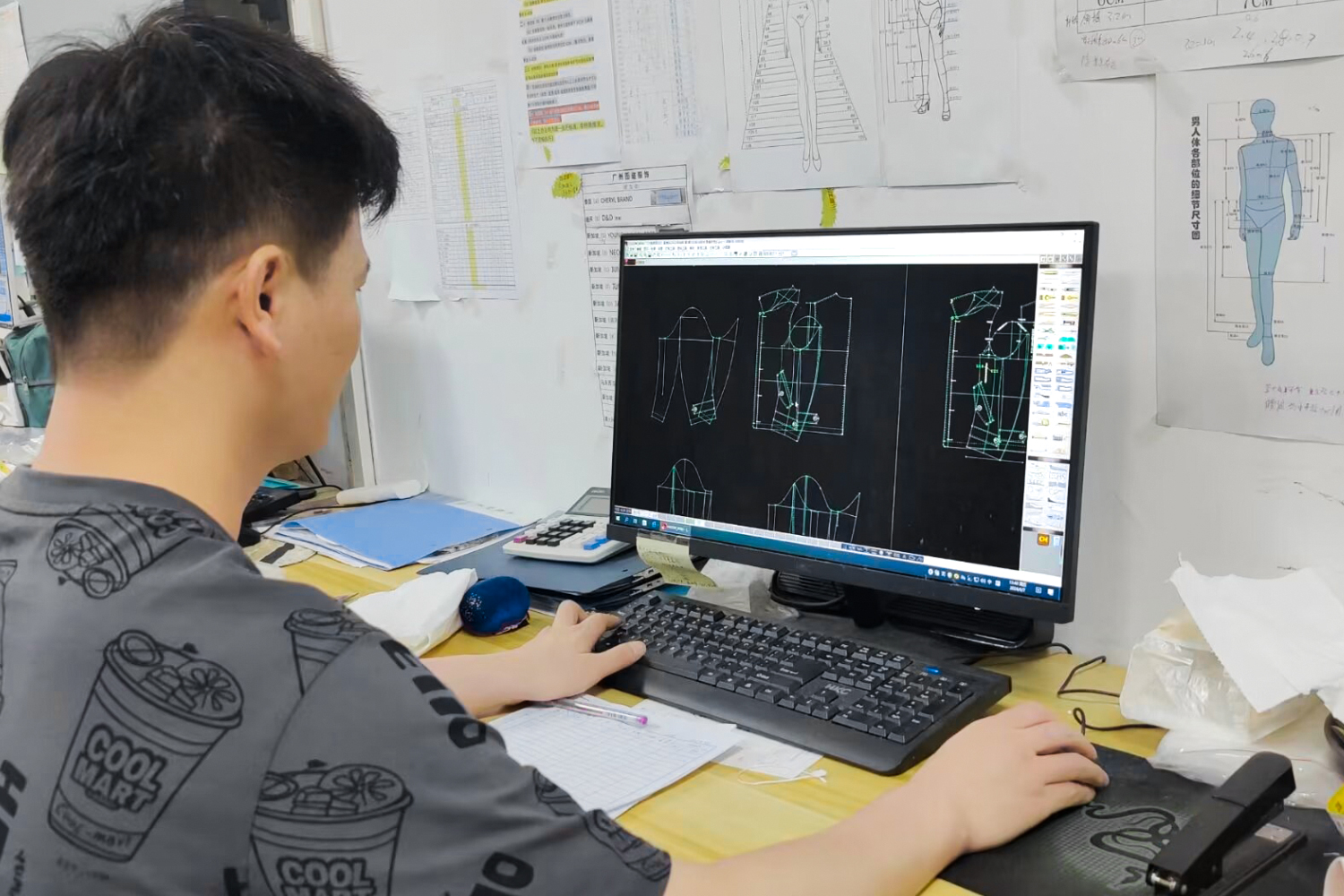
- Woven Womenswear (Dresses, Tops, Tailoring): Requires CAD pattern grading, spreading tables, straight-knife/CNC cutters, single-needle lockstitch machines, French-seam attachments, and fusible interlining presses.
- Fully-Fashioned Knitwear (Sweaters, Knit Dresses): Is not cut from rolls of fabric at all—it is knitted directly from cones of yarn on computerized flatbed knitting machines (Stoll or Shima Seiki, calibrated by needle gauge from 3GG to 16GG) and assembled panel-by-panel on precision point-to-point linking machines.
- Denim & Jeanswear: Requires heavy-duty double-needle chainstitch machines, bar-tack reinforcement, specialized rivet/shank button presses, and licensed industrial denim washing laundries capable of ozone, laser, enzyme stone washing, and potassium permanganate alternatives.
When a brand tries to source a 12-style seasonal collection by hiring three separate factories in three different cities, they end up juggling three merchandising teams, three separate MOQ thresholds, mismatched color dye lots across coordinates, and three separate QC and freight bills. Here is how southern China’s regional clusters actually work—and how our integrated network solves multi-category production for contemporary womenswear brands.
1. Regional Supply Chain Comparison: Guangzhou vs. Dongguan vs. Foshan vs. Ganzhou
Within a 90-minute radius in the Pearl River Delta (plus the directly connected inland manufacturing corridor in Southern Jiangxi), each city holds a distinct competitive advantage in global womenswear production:
| Manufacturing Cluster | Core Category Specialization | Upstream Material & Technical Advantage | TUER Garment Facility Footprint | Standard Sampling & Bulk Lead Times |
|---|---|---|---|---|
| Panyu, Guangzhou (Guangdong) | Woven dresses, blouses, skirts, tailored blazers, linen resortwear, modest clothing & rapid R&D sampling | 25 mins from Zhongda Fabric & Trims Market (50,000+ textile & hardware suppliers); fastest swatch sourcing & master pattern makers in Asia | Main Headquarters & CAD Sampling Centre (Room 205-206, #1020 Yansha Rd) | 5–10 working days sampling (200 new samples/week); 30–45 working days first bulk |
| Dongguan (Guangdong) | Computer-knitted sweaters, cardigans, pullovers, knit dresses & twinsets (3GG, 5GG, 7GG, 9GG, 12GG, 14GG, 16GG) | Global hub for yarn spinners (cotton, viscose/nylon, Merino wool, cashmere blends), computerized flatbed knitting & precision linking | Equity-Stake Specialist Knitwear Factory managed directly by TUER merchandisers | 5–10 working days yarn sourcing & sampling; 30–45 working days bulk |
| Foshan (Guangdong) | Custom denim jeans, denim jackets, denim skirts, bustiers & artisanal wash development | Direct access to premium rigid & comfort-stretch denim mills (10oz–14oz) and certified industrial wet/dry wash houses | Equity-Stake Specialist Denim Factory with full wash & hardware development | 5–10 working days wash-test sampling; 30–45 working days bulk |
| Ganzhou (Jiangxi Province) | Scalable woven bulk production for repeat orders & larger seasonal drops | Stable, skilled sewing workforce with lower overhead while maintaining full synchronization with Guangzhou HQ patterns & QC | TUER-Owned Bulk Production Factory (Combined 100,000+ pcs/month woven capacity) | 30–45 working days first bulk; 15–30 working days repeat orders |

2. Why Panyu, Guangzhou Is Unbeatable for Speed-to-Sample (5–10 Working Days)
In contemporary womenswear, sampling speed is entirely dictated by how fast a factory can get its hands on the right shell fabric, lining, zipper tape colour, and buttons. A factory located in an inland province or a single-mill town must wait 5 to 7 days just for courier packages of fabric swatches to arrive from Guangzhou or Keqiao before they can even cut a prototype.
Because our headquarters and CAD sampling centre are situated in Panyu, Guangzhou, with our self-owned bulk factory in Ganzhou, our dedicated fabric sourcers physically walk the aisles of Zhongda Textile Market daily. When you send us a design brief for custom jackets and blazers or woven dresses, we pull physical swatch headers within 24–48 hours, verify stock availability for 150–200 piece MOQs, and put patterns onto the cutting table immediately—delivering 200 new custom samples every week within a reliable 5–10 working day window.
Launching a Multi-Category Collection (Wovens + Knitwear + Denim)?
Stop managing multiple factories across China. Consolidate your woven dresses, Dongguan knitwear, and Foshan denim under one Guangzhou merchandising and QC team at 150–200 MOQ per style.
3. How Our Equity-Stake Model Unlocks Dongguan Knitwear & Foshan Denim at 150–200 MOQ
Historically, standalone tier-1 knitwear factories in Dongguan and specialist denim factories in Foshan refuse small-batch boutique orders under 500 to 1,000 pieces per style, or they outsource small orders to unvetted back-alley workshops with zero quality control.
Because Guangzhou Tuer Garment Co., Ltd. is a direct shareholder (equity-stake partner) in both a specialist knitwear factory in Dongguan and a specialist denim factory in Foshan, our clients bypass those barriers completely:
- Seamless Custom Knitwear & Sweaters Manufacturing: You get direct access to Dongguan’s computerized flatbed knitting machines across chunky (3GG–5GG), mid-weight (7GG–9GG), and fine-gauge (12GG–16GG) constructions, along with panel pre-washing and anti-pilling treatments, at our standard 200 pcs (1 colour) / 150 pcs per colour (2+ colours) MOQ.
- Authentic Custom Denim & Jeans Manufacturing: Our Foshan equity facility executes complex denim wash recipes (vintage enzyme stone wash, whisker/hand-sanding, eco-bleach, tinted over-dyes, and raw selvedge construction) plus custom-engraved tack buttons, rivets, and leather/vegan jacron back patches—while our Guangzhou HQ ensures the fit grading and wash shade match the rest of your seasonal lookbook.
| Operational Factor | Managing 3 Separate Factories Yourself (Woven + Knit + Denim) | Working With a Trading Company / Middleman | TUER Integrated Multi-Factory Network (Guangzhou + Ganzhou + Equity Dongguan & Foshan) |
|---|---|---|---|
| Pricing & Margin Transparency | Direct factory pricing, but high admin overhead & zero volume leverage per factory | 15%–30% middleman markup added on top of subcontracted factory quotes; zero visibility into who sews your clothes | Direct factory-floor pricing across all categories with centralized BOM procurement leverage |
| MOQ Requirements | Often forced into 300–500+ pcs per style at standalone Dongguan knit or Foshan denim plants | Inconsistent MOQs; small orders frequently shifted to low-tier workshops | Unified 150–200 pcs MOQ across woven dresses, blazers, linen, knitwear, and denim |
| Colour & Fit Consistency Across Categories | High risk of “Ivory” knit cardigan clashing with “Ivory” linen trousers; inconsistent size grading across factories | High communication delay; specs lost in translation between trading agent and factory pattern makers | Centralized Pantone lab-dip & swatch control + unified CAD grading rules managed from Guangzhou HQ |
| Quality Control & Shipment Consolidation | Must pay for 3 separate third-party AQL inspections and 3 separate domestic/international freight bookings | Minimal inline QC; problems only discovered when goods arrive at port | 100% unified QC inspection at our Guangzhou hub + consolidated single-invoice EXW/FOB/DDP shipment |
4. Visiting Our Facilities or Auditing Remotely Before Bulk Production
Whether you are planning a sourcing trip to Guangdong or managing production remotely from New York, London, Sydney, or Dubai, transparency is built into every stage of our workflow:
- In-Person Showroom & Factory Visits: Buyers visiting Guangzhou can tour our Panyu headquarters, CAD pattern room, showroom (featuring 1,000+ physical reference samples across woven, knit, and denim), and sewing floors just 35 minutes from Guangzhou South Railway Station or Baiyun International Airport.
- Remote Digital Sampling & Video QC: For remote brands, we provide high-resolution sample photography on mannequins, live video calls from our sample room, pre-production (PP) and Top-of-Production (TOP) sample shipments, and comprehensive measurement and workmanship QC reports prior to the 70% balance payment.
Partner With a Proven Multi-Facility Womenswear Manufacturer Since 2013
With 100,000+ garments monthly capacity excluding equity-stake specialist factories plus our equity-stake Dongguan knitwear and Foshan denim factories, we help fashion brands scale seamlessly from 150-piece boutique drops to global retail distribution.
Frequently Asked Questions: Pearl River Delta Apparel Manufacturing
1. If my collection includes woven dresses, knitted sweaters, and denim jeans, do I deal with one project manager or three?
You work with a single dedicated English-speaking merchandising team at our Guangzhou headquarters. Your account manager coordinates CAD pattern grading, yarn/fabric sourcing, sampling, inline QC, and consolidated shipping across our Guangzhou, Ganzhou, Dongguan (knitwear), and Foshan (denim) facilities.
2. Is the 100,000 garments per month capacity inclusive of the Dongguan knitwear and Foshan denim factories?
No. Our stated monthly production capacity of 100,000 garments covers our Guangzhou headquarters and sampling centre and our self-owned production factory in Ganzhou, Jiangxi—specifically excluding the additional dedicated capacity at our equity-stake specialist denim factory in Foshan and knitwear factory in Dongguan.
3. Can you consolidate woven, knitwear, and denim bulk orders into one single shipment to save on freight?
Yes. All completed knitwear from Dongguan and denim from Foshan are transferred to our central Guangzhou hub for final quality assurance checks, packing verification, and shipment consolidation. We then ship your entire seasonal collection together under a single EXW, FOB, or DDP air/sea booking.
4. Can I visit your Guangzhou office, sample room, and factories in person?
Absolutely. Our main office and sampling center are located at Room 205-206, #1020 Yansha Road, Panyu District, Guangzhou, China (511431). We regularly host international brand founders and sourcing directors for showroom reviews, Zhongda fabric market sourcing walks, and factory tours.


